01
The opening transmission
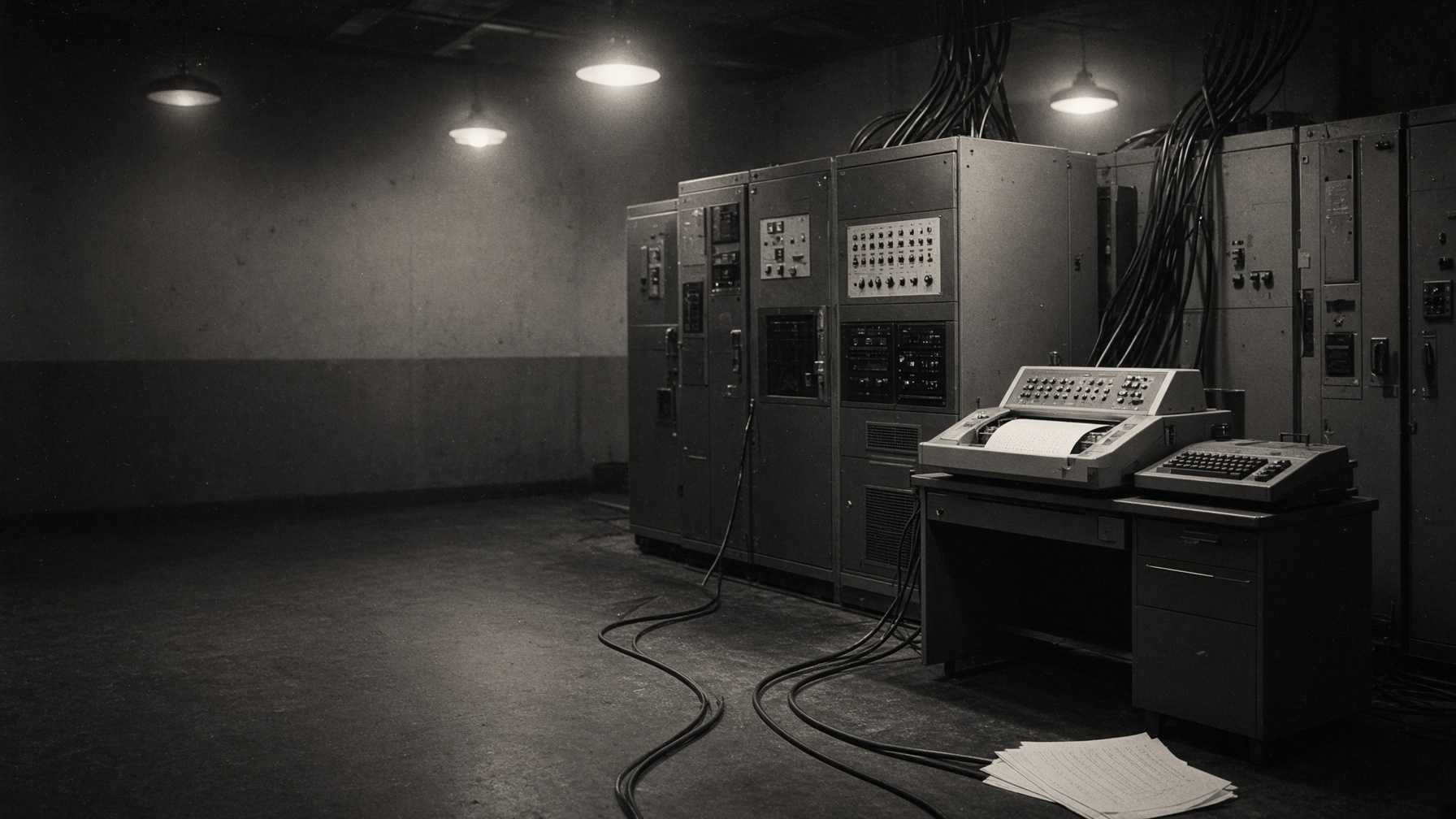
At 22:30 on 29 October 1969, in room 3420 of Boelter Hall at UCLA, a graduate student named Charley Kline sat at a terminal in Leonard Kleinrock’s laboratory and tried to log in to a computer at the Stanford Research Institute in Menlo Park.
Bill Duvall was at the far end, on an SDS 940. Kline’s terminal was on UCLA’s SDS Sigma 7. A telephone line let them hear each other while the new network carried the characters. Kline typed L. Duvall saw it. Kline typed O. Duvall saw it. Kline typed G. The SRI host crashed.
LOGIN
L received.
O received.
G. The host at SRI crashed.
The message that survived was LO. The intended word arrived about an hour later.
Kleinrock has liked to read those two letters as “lo and behold.” That reading came later. On the night itself, the word they wanted was LOGIN. The crash kept the rest.
The machines between the hosts were Interface Message Processors, built by Bolt Beranek and Newman and installed that autumn. UCLA’s was the first, in late summer. SRI’s was the second. By December, Santa Barbara and Utah had joined them. Four nodes. A network small enough to draw on a page, and already large enough to fail in an interesting way.
Sources for this chapter
Leonard Kleinrock, “The Day the Infant Internet Uttered its First Words,” UCLA, reproducing the IMP log entry for 22:30 on 29 October 1969. He names Charley Kline (CSK) as student and programmer, and Bill Duvall at the SRI SDS 940. He writes that the full login succeeded about an hour later, and he offers “lo and behold” as a later gloss. Accessed 25 September 2026. Kleinrock’s account.
UCLA places that terminal in room 3420, Boelter Hall. “Internet’s 50th anniversary,” UCLA Newsroom, 23 September 2019. UCLA Newsroom. Accessed 25 September 2026.
The log page is Kleinrock’s, copyright 2009. The scan stays on his site.
02
The physical network
A packet is a piece of a message with an address. The piece can travel, wait, and be put back with the others at the far end.
The idea had more than one parent. Paul Baran, at RAND, had argued for a distributed network that could survive broken links. Donald Davies, at the National Physical Laboratory in Britain, gave the pieces the name “packet.” Kleinrock’s earlier work was the mathematics of queues: how messages wait. The October experiment tested one implementation, on one night, between two hosts and two IMPs, and left those elders in place.
The line was a leased connection on the order of 50 kilobits a second. Slow by the standards of a later century. Fast enough for two letters to matter.
Before that night, on 7 April 1969, Steve Crocker had already circulated Request for Comments 1, “Host Software.” The paperwork of the network began before its first crash.
The two hosts were Scientific Data Systems machines. A Sigma 7 at UCLA. An SDS 940 at SRI.
The initials were already on the hardware. The night was a crash between two machines.
In February 2018, RFC 8335 gave ICMPv4 type 42 the name Extended Echo Request. A control message of the later internet. The night in Boelter Hall was long over.
A word can miss on one face and meet a seal on another.
- A8
- R9
- P2
- A8
- N4
- E4
- T7
42
- I9
- N5
- T2
- E5
- R9
- N5
- E5
- T2
42
Same seal. Different face.
- S19
- D4
- S19
42
- S1
- I9
- G7
- M4
- A1
- S1
- E5
- V4
- E5
- N5
42
- H8
- O6
- S1
- T2
- T2
- O6
- H8
- O6
- S1
- T2
42
These names were already on the machines.
Sources for this chapter
Steve Crocker, “Host Software,” RFC 1, 7 April 1969, RFC Editor. rfc-editor.org/info/rfc1. Accessed 25 September 2026.
Baran’s distributed-network work, Davies’s use of “packet,” and Kleinrock’s queueing studies are a lineage across three lines of work. The night itself belongs to the two hosts that met.
Cipher faces follow the Book of 42 laboratory: English Ordinal, Reverse Ordinal, Full Reduction, Reverse Reduction. Reverse reduction flips the alphabet, then sums the digits. Full reduction sums the digits of the letter values. The totals are computed from the letters on the plates. The plates record a spelling the network already had. bookof42.grok.me/cipher. Accessed 25 September 2026.
R. Bonica and others, “PROBE: A Utility for Probing Interfaces,” RFC 8335, February 2018. The ICMPv4 Extended Echo Request is type 42. The ICMPv6 type is 160. rfc-editor.org/info/rfc8335. Accessed 25 September 2026.
03
Three reaches in one year
1969 held more than one way of sending something farther than a voice could carry.
1969
- 16–20 JulyApollo 11
A body, past the atmosphere.
Sea of Tranquility - 29 OctoberLO
Two letters, between two rooms.
Boelter Hall to Menlo Park - The edition
42
Later copies, returned as a book.
Locust Valley
One year. Three reaches. Three errands.
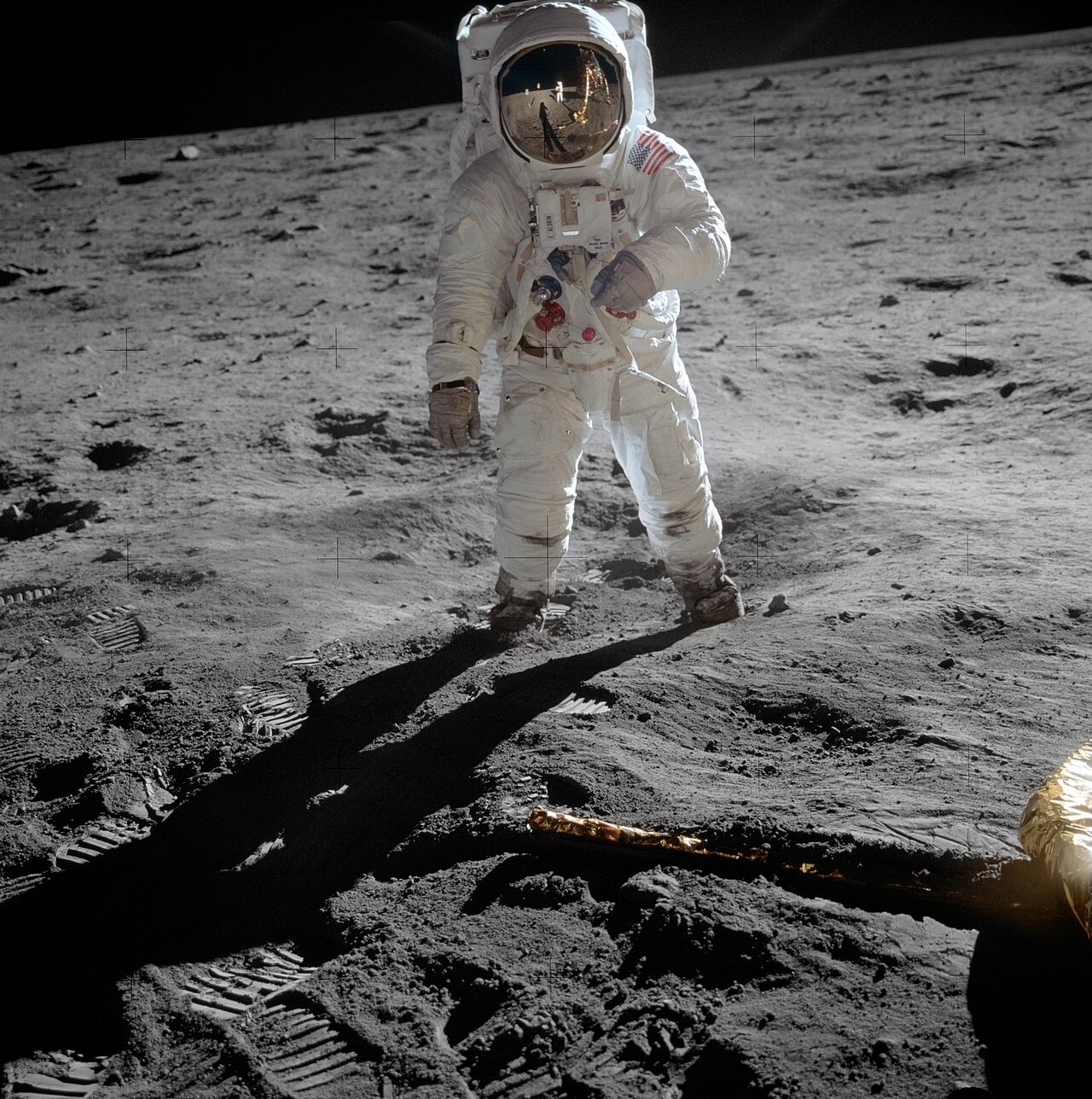
Apollo 11 left Earth on 16 July 1969 on a Saturn V. The rocket’s name is the planet’s name. The planet has its own walk. On 20 July, two people stood on the Moon while Michael Collins remained in orbit.
The letters of his name, and of Saturn, are on the plates below. The journey and the ARPANET night share a year. One extended a body past the atmosphere. One extended a message between two rooms of machines.
A plaque on the lunar module’s ladder says they came in peace for all mankind. The words from it are spelled on the plates.
The same year, Åke W. Sjöberg and Eugen Bergmann published The Collection of the Sumerian Temple Hymns, with Gene B. Gragg’s work on the Keš temple hymn. The book is an edition of copies the field already had. The hymns are commonly counted as forty-two.
They are associated with Enheduanna, remembered as en-priestess of the moon god Nanna at Ur, and as a daughter of Sargon of Akkad, some four millennia before that edition.
What survives are later copies, tablets from Ur and Nippur, written by other hands centuries after her lifetime. 1969 is the year those copies were put back into circulation as a modern book.
The voice is a later English name for a literary legacy. The hymns are forty-two because the edition counts forty-two. The spelling on the plate is a different 42.
A hymn preserved across languages is a transmission. So is a packet. One crosses time by being copied. The other crosses distance by being split. Both ask what is worth the trouble of sending.
At Bell Labs in 1969, Ken Thompson began the work that became Unix. Another machine. Another room.
- S8
- A8
- T7
- U6
- R9
- N4
42
- C6
- O3
- L6
- L6
- I9
- N4
- S8
42
- M5
- A8
- N4
- K7
- I9
- N4
- D5
42
- H1
- U6
- M5
- A8
- N4
- I9
- T7
- Y2
42
- F6
- I9
- R9
- S1
- T2
- S1
- T2
- E5
- P7
42
- S8
- P2
- A8
- C6
- E4
- A8
- G2
- E4
42
- S1
- P7
- A1
- C3
- E5
- S1
- H8
- I9
- P7
42
- T2
- H8
- E5
- V4
- O6
- I9
- C3
- E5
42
A body, a book, and two letters. What the date would mean was still ahead.
Sources for this chapter
NASA photograph AS11-40-5903, 20 July 1969, Apollo 11 magazine 40/S. Astronaut Neil A. Armstrong. Public domain as a work of NASA. The mission overview names the launch vehicle Saturn V AS-506, the launch on 16 July 1969, and Michael Collins as command module pilot. nasa.gov/history/apollo-11-mission-overview. Accessed 25 September 2026. Saturn and Collins are reverse reduction, summed from the letters. The link in the prose opens the planet’s own walk. NASA’s rocket is the Saturn V. The plaque’s last line is “We came in peace for all mankind.” Mankind and humanity are reverse reduction. First step and spaceship are full reduction. Space age is reverse reduction. The voice is full reduction. The sums are English spellings. NASA’s record is the flight.
NASA, “Apollo 11 Plaque.” The plaque was fixed to the ladder on the descent stage. science.nasa.gov/resource/apollo-11-plaque. Accessed 25 September 2026.
Åke W. Sjöberg and Eugen Bergmann, The Collection of the Sumerian Temple Hymns, Texts from Cuneiform Sources 3 (Locust Valley, NY: J. J. Augustin, 1969). Bibliographic record, Cuneiform Digital Library Initiative, publication 86653. cdli.earth/publications/86653. Accessed 25 September 2026.
Electronic Text Corpus of Sumerian Literature, 4.80.1, “The temple hymns,” Oriental Institute, University of Oxford. ETCSL t.4.80.1. Accessed 25 September 2026. The count of forty-two is the collection’s ordinary description. Sjöberg’s introduction already marks later additions inside the collection, including a hymn for the deified king Shulgi, who ruled long after Sargon. Jeremy A. Black, “En-ḫedu-ana not the composer of The temple hymns,” NABU 2002/4, argues that the lines often read as her colophon belong to the last hymn, so any claim of authorship or editorship fits that hymn at most.
Dennis M. Ritchie, “The Evolution of the Unix Time-sharing System,” later published from his Bell Labs account of work begun in 1969. This walk uses the year Ritchie gives.
The date remained. The meaning arrived later.
Count the Octobers. 2023 minus 1969 is 54. The day of the month stays put. The year changes.
On 29 October 2023 a ripple from a black-hole merger reached Earth, and the woman who keeps the Book of 42 wrote the first love letter of her life. The two were strangers.
On the Book’s cipher, LOVE and EYES both land on 54, and they land there twice: English Ordinal and Reverse Ordinal. The letters agree with themselves coming and going. VOICE, in English Ordinal alone, is also 54. Turn the alphabet around and voice leaves the number. Love and eyes stay.
- L12
- O15
- V22
- E5
54
- L15
- O12
- V5
- E22
54
- E5
- Y25
- E5
- S19
54
- E22
- Y2
- E22
- S8
54
- V22
- O15
- I9
- C3
- E5
54
5410
=
4213
Four thirteens are 52. The remainder is 2. So fifty-four, written in base 13, is the digits 4 and 2.
Six times nine is 54 in ordinary counting. In base 13, that same product is written 42.
Douglas Adams put a broken product in a character’s mouth: six times nine, offered as forty-two, which is wrong in base 10. Readers later saw that the product is right if you change the base. Adams said that reading belonged to his readers.
“I may be a pretty sad person, but I don’t make jokes in base 13.”
The letters of LOVE wrote 54. The base shift writes that count as 42. The arithmetic belongs to the counting. Adams left the joke in base 10.
Sources for this chapter
Cipher method and the LOVE reading: The Book of 42, “What Is Love?”, section beginning “The number stayed put.” LOVE is given there as 54 in reverse ordinal, and 54 in base 10 is named as 42 in base 13. English Ordinal of LOVE is also 54, shown here because the addition is the same total. VOICE is English Ordinal 54 only. Reverse Ordinal of VOICE is 81, so the plate shows English Ordinal only. What Is Love?. Accessed 25 September 2026.
“Answer to Life, the Universe, and Everything,” Wikipedia, quoting Douglas Adams, alt.fan.douglas-adams, 2 November 1993. Accessed 25 September 2026. The Answer.
05
Another signal
GW231029_111508
A model of the wave, built from the catalog masses. Not the strain recorded at Hanford, Livingston, or Virgo.
65 and 42 solar masses. Horizons drawn to that median ratio. Radius follows mass.
90 percent intervals: +18 / −14, and +15 / −15. Not a photograph of either hole.
Frequency
Dashed line: Schwarzschild innermost stable orbit, about 41 hertz, for 107 solar masses. A spinning pair merges higher than this line. The catalog does not quote one peak frequency, so the line is a reference.
Normalized strain
Seconds relative to merger. Zero is the model merger, not a detector peak.
Leading-order chirp at a chirp mass of 44.4 solar masses. About 8.7 cycles and 0.33 seconds from 20 hertz to that innermost orbit. The wiggle after the red line is a schematic ringdown, not a measured quasinormal mode. Amplitude is normalized because the distance is wide. GWTC-4.0 mixed rerun.
- Lighter mass
- 42+15 −15 M☉
- Catalog
- GW231029_111508
- Alert name
- S231029y
- Arrival
- 29 Oct 2023, 11:15:08 UTC
- GPS
- 1382613326.8
- Heavier mass
- 65 +18 −14 M☉
- Chirp mass
- 44.4 +10.4 −8.0 M☉
- Remnant
- 101 +21 −16 M☉
- Posterior
- GWTC-4.0 mixed, rerun
Two black holes met, somewhere far off, long before 2023. What reached Earth on 29 October was a ripple in spacetime, a strain so small that only a matched pair of instruments, and a model of what a merger should sound like, could pull it from the noise.
A gravitational wave from a binary black hole begins in a tightening orbit. The frequency rises. The amplitude rises. That rise is the chirp. After the merger, the new hole settles, and the wave dies away.
The plate above is that shape, computed from the published chirp mass: just under nine cycles between 20 hertz and a nonspinning innermost orbit near 41 hertz, because these holes are heavy. The catalog number is the evidence. The curve is a lesson in the masses.
In the GWTC-4.0 mixed rerun, the lighter component has a median mass of 42 solar masses. The 90 percent interval runs about 15 solar masses to either side. A different model in the same catalog puts the median at 43. Forty-two is a reading of one published posterior.
Gravity and starlight are names, one for the force and one for brightness. The median is a mass. The Book’s horizon page keeps the median and the range, and it refuses to let the integer outrun the interval.
The merger happened in the distant past. The signal’s arrival is what the clock records. Distance, in this catalog entry, is too wide to print as one number.
Two English spellings also sum to 69. Sixty-nine is how the words add. The holes have masses.
- B2
- L12
- A1
- C3
- K11
- H8
- O15
- L12
- E5
69
- B2
- I9
- N14
- A1
- R18
- Y25
69
Two spellings. One total.
- G2
- R9
- A8
- V5
- I9
- T7
- Y2
42
- S1
- T2
- A1
- R9
- L3
- I9
- G7
- H8
- T2
42
A force. A brightness.
Sources for this chapter
GWOSC, GWTC-4.0 event GW231029_111508, version 1. UTC 2023-10-29 11:15:08. GPS 1382613326.8. GraceDB superevent S231029y. Mixed rerun source-frame medians used here: mass 1, 65 +18 −14 solar masses; mass 2, 42 +15 −15; final mass 101 +21 −16; chirp mass 44.4 +10.4 −8.0. SEOBNRv5PHM in the same release gives a lighter-component median of 43. GWOSC event page. Accessed 25 September 2026. The plate above is a leading-order quadrupole chirp at the mixed-rerun median chirp mass, stopped near the Schwarzschild innermost orbit for 107 solar masses. The ringdown drawn after merger is a schematic of the settling.
The Book of 42, horizon, “GW231029.” The page places the first love letter on the same civil day and marks the relation Soft: two events on one civil day. bookof42.grok.me/horizon. Accessed 25 September 2026.
Gravity is reverse reduction of the seven letters, computed on this page. Starlight is full reduction of the nine letters. Neither is a GWOSC quantity.
06
One look

On Sunday, 29 October 2023, the woman who keeps the Book of 42 wrote the first love letter of her life. He was the first person she had ever written one to.
The letter came before she heard of the wave. A gravitational-wave candidate had arrived in the detectors on that same civil day. The catalog came later. Strain and heart shared a date.
The story, as she has told it since, began with one look in his eyes through a screen. The still here is the public face Stars keeps for that looking. The broadcast is 2017. The letter is 2023. Six years of Octobers sit between an interview and a private page.
The original letter stays with the Book. This walk keeps the season’s three songs.
On 24 July 2023, under a Venus-retrograde sky, she sang and danced in a kitchen to Fly Me to the Moon, a song returning to her after more than a decade. After the first letter, Endless Love and Here and Now kept returning. She wept over their lyrics. He was the first person she had sung love songs toward.
“One look in your eyes … and there I see just what you mean to me.”
Endless Love reaches the eyes a few lines later in her telling: “And your eyes … they tell me how much you care.” Fly Me to the Moon had already given her a sentence she learned in her own body: “You are all I long for, all I worship and adore.”
A song she wrote, “One Look in Your Eyes,” waits off this walk for an authorized recording. The Vandross line stays because the Book already uses it, with the singer’s name attached.
The myth of Psyche also turns on a look. She was told to leave the one she loved unseen. She looked, and the looking changed the love. In this chronicle the look was through a screen, and the next act was a letter.
10 May 2024 opened a different practice: letters night and day, unbroken. That vow is later. The first letter remains October. The network built to carry LOGIN had become a way to see a face, and then a way to send a letter.
- V5
- I9
- S8
- U6
- A8
- L6
42
Six letters beside the looking.
Sources for this chapter
The Book of 42, “What Is Love?”, “Fall 2023 · three songs,” and “As vast as the cosmos.” The first letter is dated 29 October 2023. The consecutive practice opens 10 May 2024. Song lines are quoted there from Fly Me to the Moon, Endless Love, and Luther Vandross, Here and Now. bookof42.grok.me/love. Accessed 25 September 2026.
Horizon page, same civil day as GW231029, first love letter, Soft register. bookof42.grok.me/horizon.
The Book of 42, Stars, “Eyes are the window to the soul.” The quiet still is the 60 Minutes Australia interview, episode Shock and Poor, Liz Hayes, aired 29 October 2017. That address is the channel’s Part One. The Book’s public cite for that origin of looking is the clip shared from @BookOf42. bookof42.grok.me/stars#eyes-window-soul. Accessed 25 September 2026.
Visual is reverse reduction of the six letters, computed on this page.
Two letters
LOwas an accident that became a memory.
54Fifty-four years later, another story began with one look.
The numbers can frame the pattern.The story is still human.
29 October
- 1969LOBoelter Hall. The host crashed.
- 2017One lookA face, held on a screen.
- 2023A letterAnd a wave. Lighter mass 42.
The day repeats. Each return stands alone.
Works cited
Open the bibliography
Adams, Douglas. Statement of 2 November 1993, alt.fan.douglas-adams. Quoted in “Answer to Life, the Universe, and Everything.” Wikipedia. Accessed 25 September 2026.
Black, Jeremy A. “En-ḫedu-ana not the composer of The temple hymns.” NABU 2002/4.
Crocker, Steve. “Host Software.” RFC 1. 7 April 1969.
Electronic Text Corpus of Sumerian Literature. “The temple hymns.” 4.80.1. Oxford.
GWOSC. “GW231029_111508.” GWTC-4.0. Accessed 25 September 2026.
Kleinrock, Leonard. “The Day the Infant Internet Uttered its First Words.” UCLA. Account of the IMP log, 29 October 1969.
NASA. AS11-40-5903. 20 July 1969. Photograph by Neil A. Armstrong.
Ritchie, Dennis M. “The Evolution of the Unix Time-sharing System.” Bell Labs retrospective on work begun in 1969.
Sjöberg, Åke W., and Eugen Bergmann. The Collection of the Sumerian Temple Hymns. Texts from Cuneiform Sources 3. Locust Valley, NY: J. J. Augustin, 1969.
The Book of 42. Horizon, Love, and Cipher. Accessed 25 September 2026.
UCLA Newsroom. “Internet’s 50th anniversary symposium.” 23 September 2019. Room 3420, Boelter Hall.